U.s. Beef Producers Say New Labeling Rules Could Spark Trade War
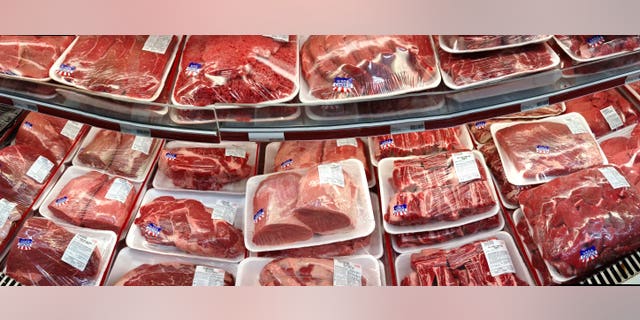
FILE - In this Nov. 2, 2013 file photo, various cuts of beef and port are displayed for sale in the meat section at a discount marketplace in Arlington, Va. Cattle groups from the U.South. and Canada are upset that a new Farm Beak passed by the House on Wednesday, January. 29, 2014, fails to brand changes to country-of-origin labeling requirements. The rules crave detailed labels about the origins of beef, pork and craven sold in U.Due south. stores. (AP Photo/J. Scott Applewhite, File)
NEWYous can now listen to Play a trick on News articles!
SIOUX FALLS, Due south.D. (AP) – Meat and livestock groups upset that Congress opted in the new farm bill not to back off from mandatory land of origin labeling requirements are worried the issue could start a trade war with Canada and Mexico.
Previous labeling rules required only the land of origin to exist noted, such equally "Product of U.Southward." or "Product of U.South. and Canada." New rules that took effect concluding year require that labels for steaks, ribs and other cuts of meat include clear information about where the animals were born, raised and slaughtered. Labels must specify, for instance, "Born in United mexican states, raised and slaughtered in the Usa."
"That'south a really large label on a parcel of meat that doesn't really guarantee anything," said Cory Eich, president of the South Dakota Cattlemen'southward Association.
Country of original labeling supporters, including consumer groups, environmental groups and some independent farmers, say the requirements give consumers valuable data. But livestock groups and meatpackers say it'south costly to have to segregate and track animals along the unabridged supply chain
Eldon White, executive vice president of the Texas and Southwestern Cattle Raisers Association, said a number of his grouping's members along the border have ranches in both Texas and Mexico, and those operations typically use the aforementioned bulls between ranches. Having to split calves by nativity nation cuts downwardly on profit, he said
"The quality of the cattle is identical, and yet the cattle coming from Mexico are being discounted between $40 and $lxx a head because of the additional accounting requirement," White said
Eich, a moo-cow-calf rancher from Canova, S.D., said state of origin labeling too ofttimes is incorrectly portrayed as a food safe event, as all meat sold in the United States is inspected by the U.S. Department of Agriculture. He noted the dozens of voluntary marketing programs, such as Certified Angus Beef, that allow consumers to buy whatever they desire
"It'south perceived sometimes that we're confronting country of origin labeling, and it'due south non that," Eich said. "Nosotros're against the mandatory part."
Senate Agriculture Chairwoman Debbie Stabenow, D-Mich., said the subcontract bill is a huge win for ranchers, as it includes a permanent livestock disaster assistance program, a livestock fodder program and export assistance. Simply some of the groups came in to the House and Senate wanting to repeal country of origin labeling and "there was no manner," she said
"The votes were not there in either body to do that," Stabenow said during a Jan. 28 subcontract nib briefing call. "And and so we moved frontwards to reach what we could together."
Congress' decision not to address the issue has drawn criticism from Canadian officials, who say the state may retaliate past imposing tariffs on a wide range of American products
Federal Agronomics Minister Gerry Ritz and International Trade Minister Ed Fast said the detailed origin labels drive upward the price of Canadian exports and undermine competitiveness, causing most $1 billion a year in losses. A public hearing earlier the Earth Trade Organization is set up for February. 18 in Geneva
"By refusing to fix land of origin labelling, the U.Due south. is finer legislating its own citizens out of piece of work, and harming Canadian and American livestock producers akin past disrupting the highly-integrated North American meat industry supply chain," the ministers said last week in a argument
Kenny Graner, a farmer and rancher with a 250-caput moo-cow herd in Due north Dakota's Morgan County, said he is surprised by Canada's reaction to the labeling mandate because near residents of the United States' northern tier know that the quality of the breeds are nigh identical
"Canada is merely 100 miles n of usa," said Graner, president of the Independent Beef Clan of North Dakota. "They have the aforementioned genetics and quality of beef that nosotros have. Canada should be wrapping themselves around land of origin and wanting to distinguish themselves separate from Mexico, Brazil, Argentina, Australia."
A one-half dozen national meat groups expressed their concern most the trade threats in a Jan. 27 letter of the alphabet to the ranking members on the House and Senate agriculture committees
The American Meat Plant, the National Catttleman's Beef Association, the National Chicken Council, the National Pork Producers Council, the National Turkey Federation and the North American Meat Association said they offered many solutions and all were rejected. The groups say the sorting requirements add besides many costs for meatpackers
"This retaliation will be crippling to our industries and threaten the long-term relationship with ii of our well-nigh important export markets," the groups wrote. "COOL is a broken program that has just added costs to our industries without whatever measurable benefit for America'south livestock producers."
Follow us on twitter.com/foxnewslatino
Like the states at facebook.com/foxnewslatino
Source: https://www.foxnews.com/world/new-meat-labeling-laws-could-trigger-u-s-trade-war-with-canada-mexico
0 Response to "U.s. Beef Producers Say New Labeling Rules Could Spark Trade War"
Post a Comment