Alternator Failed Then Started Working Again
Dan Ferrell writes about do-it-yourself car maintenance and repair. He has certifications in automation and control applied science.
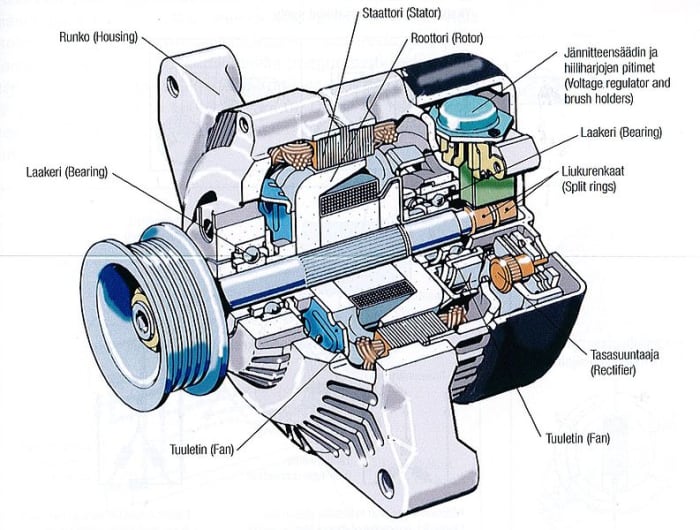
The alternator is at the heart of the charging system of your vehicle.
Photograph courtesy of Pentti Immonen on Wikimedia
Alternator problems and charging system problems can affect your vehicle in different ways. You may notice:
- your ALT or CHARGE indicator light comes on,
- your engine is hard to start and cranks slowly, or doesn't crank,
- your battery demands lots of h2o,
- your alternator makes noises,
- or your headlights suddenly go dim.
These and other problems may be caused by a fault in the charging system.
Earlier you start replacing components with the hope of fixing the problem, you need to determine which component or components are causing you trouble. Frequently, it is possible to diagnose and solve the problem on your own using a few simple tests and tools.
The sooner you lot find out what is causing trouble, the improve. You'll prevent a faulty component from ruining other parts in the system, which would brand your repair more expensive.
This convenient troubleshooting guide will assist y'all discover out what you lot need to know, using a few unproblematic checks you lot can do at home using a test light or digital multimeter (DMM) and mayhap a few other mutual tools.
It is a good idea to take on manus the vehicle repair manual (or a good aftermarket manual) for your particular car make and model. Information technology will help you identify wires, specific components, and perchance suggest some specific tests recommended by your manufacturer.
If you want to test the condition of the arrangement as a diagnostic starting signal, practice the tests described in the following section, "Full general Charging System Cheque."
However, if yous need help for a specific problem with your charging system—for example, an over-accuse or under-accuse condition, discharging bombardment, or noisy system—and so skip over to the "Charging System Issues and Potential Causes" section.
| Index |
|---|
| I. Common Symptoms of a Bad Alternator or Charging System |
| Two. Full general Charging System Checks |
| III. Charging Arrangement Problems and Potential Causes |
| 4. Troubleshooting for Unusual Voltage Organisation Drops |
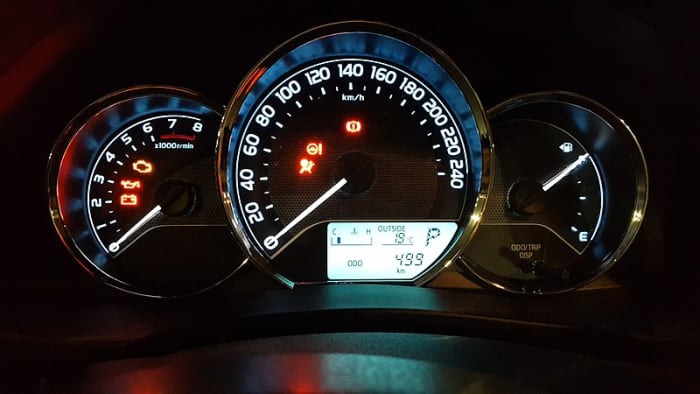
The battery indicator should plow off when your engine is running.
Photo courtesy of Kskhh on Wikipedia
I. Common Symptoms of a Bad Alternator or Charging Arrangement
Indicator Low-cal On
Usually, the first sign that your charging organization is in trouble is a "battery," "ALT," or "Accuse" warning calorie-free illuminating on your musical instrument panel while driving. It means that the alternator voltage output is beneath 12 volts, or over its limit or has stopped charging the bombardment and your machine is running on battery power.
If the light illuminates only intermittently, information technology usually indicates a loose or worn drive belt or serpentine belt, worn-out or bad carbon brushes in the alternator. Just think that the lite doesn't always mean there is a bad role; the light may be triggered by a sensor giving a wrong message or there's something wrong with the excursion itself.
Scroll to Proceed
Read More than from AxleAddict
Engine Cranks Slowly, Doesn't Creepo or Stalls
When the battery is undercharged, you may have difficulty starting the vehicle, the engine cranks slowly or doesn't crank at all. Also, the engine may stall if the alternator can't produce plenty power to run the ignition system. Go over the adjacent section on "General Charging System Checks," and, if necessary, check the section "4. Troubleshooting for Unusual Charging Organization Voltage Drops." further down in this article.
Bombardment Overheating and Using Too Much H2o
An overcharged battery causes the battery to overheat. Yous find yourself adding h2o to the battery frequently. If the problem is not taken intendance of on time, it can ruin your battery. Also going through the next department, make sure to check section IV below on "Troubleshooting for Unusual Charging System Voltage Drops"
Noises Under the Hood
Squealing, buzzing or grinding noises coming from the engine may exist acquired by bad alternator components, a loose or worn-out serpentine belt, or a faulty belt tensioner, loose alternator caster or mounting bolts, worn bearings, or faulty diodes. Run into the "Checking for Alternator Noises" subsection farther downwardly in this commodity.
Dimming Lights
If you observe the headlights, instrument panel, or interior lights dimming or flickering, power windows running wearisome, radio or gauges don't operate every bit they should, either your bombardment has a low accuse, or there's ane or more faulty diodes inside the alternator. Check your bombardment and see the "Alternator Air conditioning Voltage Leak Check" subsection further down in this commodity.
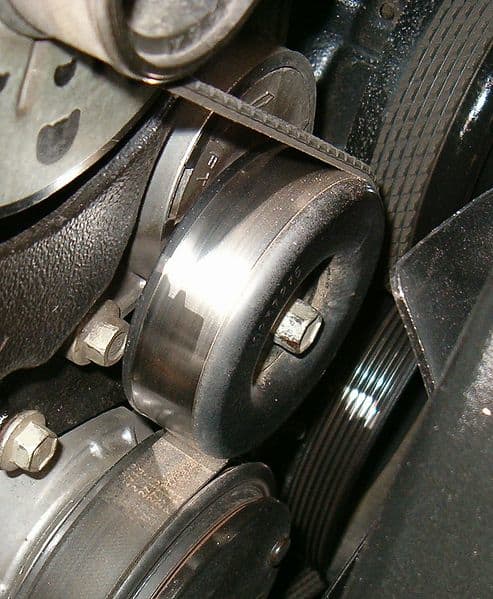
Check the bulldoze belt for aligning and tensioner for proper operation.
Photo courtesy of Una Smith on Wikimedia
II. Six Tests for the Charging System in General
These series of charging system checks help diagnose the full general condition of your charging system. They can help you confirm that you actually have a problem in your charging system and locate the source of the trouble.
1. Brand a Visual Inspection of the Organization
With the engine off, popular the hood open up and visually inspect the dissimilar components of the charging system. Look for a worn out or loose drive belt, alternator connectedness problems, loose alternator mounting bolts, and corrosion and dirt around the battery case and cables.
When inspecting the drive belt, cheque for aligning. If necessary, adapt the belt with the assistance of your car owner'due south transmission or repair transmission. Inspect the belt for signs of cracks, cuts, shiny spots, deterioration or other signs of article of clothing or damage. Change the chugalug and belt tensioner at the manufacturer's recommended interval.
2. Check for Wiring Issues
Audit the wires and connections at the back of the alternator, at the remote voltage regulator (if applicable), and at the bombardment. Expect for corrosion at the connectors, damaged wires, and burned and missing insulation that might suggest an electrical short.
3. Practice This If the Indicator Light Stays On, or Goes On and Off
Follow the side by side steps:
- Commencement the engine and use the emergency brakes. Ready the manual to Neutral (manual) or Park (automatic).
- Connect a voltmeter across the battery terminals.
- While watching the voltmeter display, start fluctuant wires at the back of the alternator, the battery, and the remote voltage regulator (if at that place is one).
- If the voltage reading on the meter display goes up while wiggling one of the wires, you've institute a bad electrical wire or connectedness.
Instead of using a voltmeter, you can have an assistant scout the indicator light on the instrument panel to see if information technology turns off as you wiggle various wires and connectors. Once the calorie-free turns off, you've found the problem connector or wire.
four. Check for Alternator Noises
Bad alternator bearings, rectifiers, rotor shaft, stator winding, skid rings, brushes and other parts inside the alternator with mechanical or electric issues can become noisy.
Here'due south a test you lot can practice: Utilize a length of vacuum hose to listen for alternator noises. The hose will amplify the noise if it's coming from the alternator. Just be very careful around moving parts while yous do this test.
- Start the engine.
- Place 1 end of the hose against your ear and move the other end effectually unlike points of the alternator body.
- Heed for whining noises (this can indicate a bad diode or an over-charging status), grinding (bad begetting), squealing, or other abnormal dissonance. If necessary, have your alternator checked.
5. Check for Under-Charging and Over-Charging
The adjacent three tests are best washed using a load tester, only you still can apply your digital voltmeter. You lot exercise this by measuring organization voltage while loading the system.
5a. First, measure out battery base voltage to make sure y'all have a fully charged battery.
- Turn on the high beams for ten seconds and then turn them off.
- Wait for two minutes
- Measure out battery voltage across the battery posts with your DMM. You should become betwixt 12.four and 12.6V. This means your bombardment is fully charged. If yous get a reading below 12.4V, charge the battery earlier continuing.
5b. Mensurate the Charging System's No-Load Voltage
- Ask an assistant to starting time the engine and hold engine speed at about 1500 RPM.
- Measure voltage beyond the battery with your DMM. Yous should go 0.5 to 2 volts higher than base voltage. If you are getting more than two volts above base voltage, most likely your alternator is over-charging the battery or the battery is faulty. Other potential problems are a faulty voltage regulator or a trouble in the charging organisation wiring. As part of your wiring checks, run into the section "Troubleshooting for Unusual Charging System Voltage Drops" below.
5c. Measure charging system load voltage with a loftier-electric current-status system measurement.
- Ask an banana to start the engine and hold engine speed at about 2000 RPM. Plough on all electric accessories similar A/C, blower motor, headlights, defroster, wipers. But don't turn on the heated windshield if your vehicle has one; alternator voltage may increase to over 100V and this can be dangerous.
- Take a voltage reading across the battery posts. Your reading should be at to the lowest degree 0.v volts above base of operations voltage for your organisation to keep up with electrical system demands. Otherwise, the charging arrangement can't meet the demand and charge your bombardment. This fault could indicate to a faulty alternator or voltage regulator. Check the section "Troubleshooting for Unusual Charging System Voltage Drops" below to bank check for wiring problems that tin can lead to this condition.
- Note: These measurements stand for to an ambient temperature of about 70º F. The charging voltage volition increase as temperature drops, and charging voltage volition subtract equally temperature goes upward. So keep this in heed when making your measurements.
6. Check for Alternator Air-conditioning Voltage Leak
Alternators use diodes to rectify alternate current produced by the alternator into direct current. When one or more than diodes go bad or a stator winding fails, the alternator tin can crusade all kinds of problems. Air-conditioning voltage leak can cause your lights to dim and drain ability from your battery, for case. Commonly, you can find this leak past measuring AC voltage at the alternator.
- Kickoff and let the engine idle.
- Set the parking restriction and your manual to Park (automatic) or Neutral (transmission).
- Set your meter to a low Air conditioning voltage range.
- Inquire an assistant to increase engine RPM to 2000 rpm.
- Touch the ruby-red meter lead to the alternator battery last B+.
- Touch the black meter lead to the alternator case (ground).
- If your DMM reads 0.four AC volts or less, the diodes are skilful.
- If your DMM reads 0.5 AC volts or more, the diodes or stator is faulty.
Once you lot've determined the condition of the organization, y'all tin can go over the next section to zero in on the potential problem(s) that may be causing the condition of the charging system.
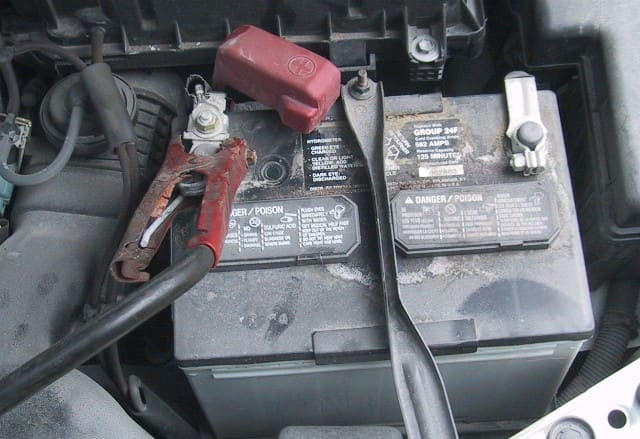
A single bad battery cell can prevent your charging system from working properly.
Photo in the public domain.
Iii. Charging Arrangement Bug and Potential Causes
To speed upwards your diagnosis and repair, look up the organisation condition that well-nigh resembles your trouble and go over the potential causes described under that status. Some checks or tests may be suggested as appropriate.
1. If the Battery Seems to Stay Undercharged
Yous have already charged your battery a couple of times and y'all simply found out the battery is undercharged once again. Before you blame your battery, or the alternator, here are some preliminary checks you may want to do.
a) Check the drive chugalug or serpentine belt, especially if you haven't replaced it in the concluding five years. Brand certain the belt has the proper tension. Look for signs of vesture or damage like cuts, shiny spots, missing chunks. Today serpentine belts don't show signs of clothing, even if they need to exist replaced. Use a belt habiliment indicator or check your maintenance schedule for the replacement interval suggested by your machine manufacturer. You may discover the schedule in your car owner's transmission or your repair manual.
b) Along with the bulldoze belt, check the belt tensioner as well. Make sure it turns freely and is noise-gratis. Car manufacturers recommend replacing the tensioner at the aforementioned fourth dimension you supervene upon the drive belt.
c) Brand sure your bombardment connections are tight and make clean. However, just because the terminals look clean, it doesn't mean they are tight and in good condition. Look for impairment to the cable and the terminal itself that may prevent proper electric current flow.
d) Check your bombardment yourself, or take it to your local auto parts store. Many of these stores will exam your bombardment for gratis.
due east) There'due south a parasitic battery drain stealing power from your battery.
- A quick test is to connect a exam light in serial between the positive battery cable and the positive battery mail. If the test low-cal comes on, there is an electrical drain in one of the systems.
- Kickoff, unplug the alternator electrical connector. If the examination light goes out, the alternator is causing the drain. If not, locate the parasitic drain.
f) Don't overlook the starter motor: a failing starter motor may describe excessive current during operation, draining bombardment power. If necessary, have your starter motor or starting organisation tested.
g) If you recently added an electrical accessory to the vehicle, you may have over passed your alternator's chapters.
h) There could be an alternator wiring problem.
i) Have the alternator and battery checked.
two. If the Organization Seems to Be Over-Charging
Besides test results, another potential sign that your battery is being overcharged is that your battery terminals keep accumulating corrosion.
Here are some checks you want to do:
- Make certain that all the connections to the alternator, remote voltage regulator (if applicable) and bombardment are clean, tight and in skillful condition.
- Bank check your bombardment or have information technology tested at your local auto parts store. A bad battery cell can cause the alternator to over-charge the good battery cells.
- Bank check for a bad alternator voltage regulator and excursion. Consult your vehicle repair manual, if necessary.
- Make sure you have good ground connections at the alternator (alternator case) and voltage regulator, especially if your vehicle uses a remote voltage regulator. Grounds should be complimentary of rust, and the alternator and remote voltage regulator mounting bolts should be make clean and tight.
- Cheque the alternator rectifier or have your alternator checked at the motorcar parts store.
- Too, deport the tests described in the Troubleshooting for Unusual Charging System Voltage Drops below.
3. If the Alternator Is Not Charging the Bombardment
When your tests bespeak to an under-accuse or no-charging status:
- Make sure the drive belt is non loose or worn out.
- If necessary, borrow a practiced battery but to operate the engine and confirm that your drive belt and belt tensioner are operating properly.
- Manually cheque the belt tensioner for proper operation. Make sure the tensioner caster turns freely and without dissonance. Check it for damage.
- Manually turn the alternator pulley and brand sure it turns without a trouble. If i of the bearings has seized, it won't allow the alternator to plough freely.
- Check that the connections at the battery, alternator, and remote voltage regulator are make clean and tight.
- Bank check for a diddled fuse or fusible link. Consult your vehicle repair transmission, if necessary, to locate the alternator fuse or fusible link.
- Do the tests described in the section "Troubleshooting for Unusual Charging System Voltage Drops" beneath.
4. If the Engine Makes Noises
Dissonance tin be a sign of alternator issues when it comes from the charging organization. The next checkpoints will help you isolate the source of the noise.
- Check the bulldoze belt or serpentine belt. Wait for signs of wear or damage like cuts, shiny spots or missing chunks nether the belt. A worn out chugalug tin squeal during operation.
- Also, check the belt tensioner for proper functioning and damage. It should rotate freely.
- Make sure the alternator is properly mounted. Loose mounting bolts tin can crusade the alternator drive belt and drive pulley to become misaligned and noisy.
- Check the alternator for noises. See the General Charging System Checks section for a simple procedure for this.
5. If Lights Dim During Engine Operation
Near alternators use diodes inside a rectifier to turn Alternating Current (Ac) into Direct Current (DC) for use by the system. When 1 or more diodes go bad, Air-conditioning can leak into the electrical system. Sometimes yous can notice this when the headlights, instrument panel lights, and other interior lights dim during engine operation. To test your alternator for Air-conditioning current leaks, come across the Alternator Ac Voltage Leak Check subsection in the previous section.
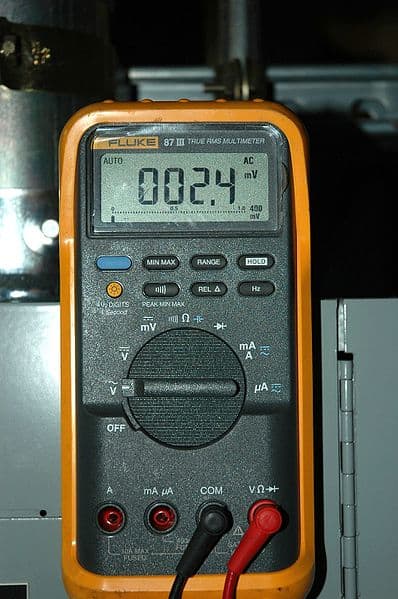
Measure organization voltage and drop voltages using a digital multimeter.
Photograph courtesy of Steve C on Wikimedia
IV. Troubleshooting for Unusual Charging Arrangement Voltage Drops
A charging system voltage drop bank check can help you locate the source of an under-accuse or over-charge condition due to problems in the wiring or connections between the battery and alternator.
one. Outset the engine and let information technology idle. Apply the parking brake and set the manual to Neutral (transmission transmission) or Park (automatic transmission).
two. Plough on the high beams to provide a system load. And take an banana raise engine speed to almost 1500 RPM. If your vehicle is equipped with a heated windshield, don't plow it on; this tin can make alternator voltage get over 100 Five. Since y'all'll exist working around alternator connections, this could exist dangerous.
3. With your voltmeter test leads, impact the positive battery post and the B+ terminal connector at the back of the alternator.
4. Check your meter brandish. You should get effectually 0.4V or less of voltage drop. If your voltage drop is college, it can lead to an under-charge condition. Cheque the connections in that office of the circuit for a loose wire, corrosion at the connectors or wiring damage that may prevent proper electric current flow betwixt the battery and alternator. Besides, bank check the electric connections at the back of the alternator and at the voltage regulator.
5. Now repeat the test, but this fourth dimension, connect your meter leads between the battery negative mail service and the alternator instance.
6. Bank check your meter brandish. Again, you should become a voltage reading around 0.2V or less. If your voltage drop is higher, there'south something wrong. This can lead to an over-charging condition. Checking that part of the circuit, make sure the bombardment basis connectedness is proficient, clean and tight. Add a temporary footing connexion from the battery to the chassis. If this removes the high voltage drop, bank check the engine to torso grounds connections. They should be clean, tight and in good condition.
Watch the next video for a visual reference on voltage drop checks.
Alternator problems are not uncommon later on a few years of operation. A typical alternator may last anywhere from viii to 12 years. So don't be surprised to find your alternator going bad or the system developing problems after a few years of trouble-gratis performance, even if you have maintained your car well.
The key point here is to do the proper diagnostic every bit soon every bit possible because a bad alternator tin can ruin an otherwise skilful battery, and other components likewise, depending on the fault.
One time you decide that your alternator is bad, you have several options. You can replace it with an original ane from your dealer, an aftermarket replacement, or a rebuilt unit. Aftermarket alternators are a skillful option and less expensive, and many of them are only equally good as their OEM counterparts. And rebuilt alternators are not as bad either. And so consider your options.
This content is accurate and true to the best of the writer's cognition and is not meant to substitute for formal and individualized advice from a qualified professional.
Questions & Answers
Question: I have a 2000 Monte Carlo and my bombardment light is nonetheless coming on afterwards changing my starter and battery and alternator. Mmy car will shut off afterwards 2 to three minutes. What could be the problem?
Answer: The problem could be in the charging excursion. This other mail may assistance:
https://axleaddict.com/auto-repair/Charging-System...
Question: I got a 2012 Nissan Xterra. I only installed a new alternator and new battery. It starts up expert and idles good now too, just when I give it full throttle and go close to 3,000 RPMs, my bombardment low-cal and park restriction lights comes on and flashes at me. And the battery volt gauge goes down a whole lot. What could be the problem?
Reply: Cheque the alternator belt and tensioner. Chugalug should have the proper pressure level. If it's loose, it won't accuse properly during hard accelerations. Check voltage at the bombardment when accelerating (at idle and emergency brakes practical). Y'all should get effectually 13.v or so. Otherwise, there could exist a problem with the voltage regulator. You may need to replace the alternator. If non, check the wires and connections between the battery and alternator.
Question: I've got a 1982 Chevy K10 half dozen.2L and I swapped the alternator. Information technology's charging but it's charging slowly. Information technology's running at 12.fourscore volts constantly. I'yard out of ideas?
Respond: Check the connections. A loose, corroded or damaged wire or connectedness can cause this type of problems:
https://axleaddict.com/auto-repair/Charging-System...
If the alternator was working fine in the other vehicle, have the battery tested if necessary.
Question: I use a Golf 4 alternator on a Golf four as I saw fit. It runs fine, and at that place aren't any alarming sound. The problem is that information technology doesn't charge when I offset the auto. I take to rev the engine hard, then it starts to charge normally. What the problem?
Answer: If the alert light is coming on when you rev the engine, check the lite excursion. specifically, you should check the resistors in the approximate cluster.
Bank check the drive belt first for tension and wear. Too, make sure that the back wires are properly connected and make clean. Then, cheque the voltage regulator.
Question: Why is the alternator overheating fifty-fifty though the engine is off?
Respond: Cheque your bombardment and circuit between the battery and alternator. Also, cheque if there are any modifications to the organisation?
Question: Bombardment tested fine, but alternator voltage would go up and downwards. Occasionally, a BATTERY SYSTEM FAILURE calorie-free will come on. Could it be a sensor/fuse problem since it doesn't stay on all the fourth dimension?
Answer: The alternator could be faulty. Only you lot may desire to run a voltage drop test on the circuit first. Some models, similar GM, have a fusible link in the excursion. Brand certain that it's skilful. This other post has a voltage drop section that may help:
https://hubpages.com/auto-repair/Charging-System-C...
Question: When my engine is at idle the voltage is around 13V, but when I turn on the headlights and Ac, information technology drops to 11V to eleven.8V. What seems to exist the problem?
Answer: My gauge is the AC caster may exist putting a strain on the crankshaft caster, affecting alternator output. Or the AC pulley is affecting the belt. Bank check how the 3 operate when the Air conditioning is on.
Question: I have an 04 Lincoln aviator. I changed the bombardment, alternator and I am still getting a bank check charging system message. What do I do next?
Answer: Make sure you actually take a charging problem. Your local motorcar parts store can check the alternator and battery for yous. If there's a trouble, information technology could exist in the circuit. If not, the circuit for the warning low-cal might be the issue.
Question: I have a 2006 Toyota Yaris T3 998cc plate. My wife went to showtime it. It wouldn't start. It tried but was like the bombardment was apartment. I wiggled the wires going to the alternator and information technology struck up hands. Do these symptoms hateful the alternator is no good?
Answer: Check get-go the wires for a loose or dirty connexion; frayed wires, etc.. Checking voltage drib on the connections and wires tin can help a lot to locate faulty connectors and wires. This other postal service may help.
https://axleaddict.com/machine-repair/Automotive-Volt...
Question: I have a 06 Mustang GT. I replaced the alternator because it was causing a camshaft position sensor code. After replacing it and checking my work, the battery light with a alarm "cheque charging system" comes on. It comes on for a minute or then then goes out for a few minutes. The bombardment seems to stay around 13.7 volts what could be causing the light to come up on randomly? I have non driven information technology yet.
Reply: Check the circuit connections. This could be a loose or bad wire/connector. Yous may want to try a voltage drop examination. This post gives you an idea of the exam:
https://hubpages.com/car-repair/Automotive-Voltag...
Question: I take a 2001 Toyota Solara with 158,000 miles. I've gone through five alternators in nearly 6 yrs. Even the Toyota oem. Two reliable mechanics can't effigy information technology out. I'chiliad taking it to a shop that specializes in electrical problems. Exercise y'all have any ideas?
Answer: Knowing how the previous alternators failed can give a clue virtually the type of issue y'all are dealing with (electrical, mechanical). Commonly when alternators failed prematurely is because of a bad bombardment (electrical), voltage regulator problems, high electrical loads (east.g. running AC fan at high) or a bulldoze belt that is putting unusual stress on the alternator caster (mechanical)(brand sure the chugalug is not also tight). Alternator quality can be another factor of course.
Check for signs of fluid leakage around the alternator that might affect the stator or rotor or both.
Question: I have a good alternator, only my battery runs down. It passed tests performed at two auto parts stores. When this problem occurred, I was able to become home by starting the vehicle (2000 GMC Yukon, v.3L) past disconnecting the battery. Voltage when upwardly shut to 14 according to the guess. When I reconnected the batter at dwelling house, information technology was still expressionless. Got a new battery and have the aforementioned problem with bombardment drain. Practise you have any ideas?
Answer: If y'all take some power amplifier, or some other power accessories, this could be running down the battery if the alternator tin can't continue up with the demand. Other than that, you may want to accept the alternator checked in a shop, and run into where the charge is going while the engine is running.
You lot can check for a parasitic drain that y'all may not exist aware of. This mail can aid y'all:
https://axleaddict.com/motorcar-repair/car-batterydrai...
Question: I installed a new 105-amp alternator in my 1982 Chevrolet C10. When I beginning the engine, it indicates 14.6 volts on the voltmeter connected to the bombardment. When I start the Ac fan and the Air-conditioning compressor, the voltage increases to 15.8 volts. Later on a while, the alternator stops charging; I think it might be lacking. I inverse 2 alternators, but I yet have the aforementioned problem. What exercise you lot call up?
Reply: Check the voltage regulator and the battery. An car parts shop may cheque the battery for yous. As well, may sure the excursion connections for the charging organization are make clean and tight and check the engine body grounds.
Question: I have a 2004 Taurus, and I've changed the bombardment and alternator but the charging arrangement light is still on. Any ideas why?
Answer: Check the fusible link, y'all can test it with your multimeter.
Question: I have a 2005 Ford Taurus one day it wouldn't start. It finally started and flashing lights to check the brake system in the charging arrangement, merely and so it wouldn't kickoff once information technology was jumped. It kept stalling, then we had it checked at an auto parts store. They agreed alternator replaced the alternator and it is yet doing the same thing do yous have whatsoever idea what else could be incorrect?
Answer: Check all the grounds -- bombardment to body and body to engine. They should be clean and tight. Bad grounds tin eventually, damage the alternator. Exam for voltage driblet on the grounds, battery and charging system.
Question: I had my alternator rebuilt. Now I am having a problem getting information technology to charge at idle, I become 14.five volts at 1500 rpm, but as presently equally I release the throttle it drops downwards to battery voltage, I've returned the alternator once already. He checked it again, replaced the regulator and said it's putting out full voltage, but on the motorcar, information technology'southward doing exactly as I mentioned earlier, no voltage at idle, full voltage when revving the engine. Could this be a PCM issue?
Answer: Check the belt and belt tensioner for the correct tension. Accept a wait at the connections at the back of the alternator, especially the B+ connector. On early models the indicator calorie-free on the dashboard should come on when the ignition primal is in the On position, otherwise, you'll take problems at idle. There could likewise be a trouble in the charging circuit, a loose, corroded or damaged wire can also prevent full voltage at low rpm. Have a expect at the grounds and the output wiring to the battery. You may need the diagram for this. These other posts may help:
https://axleaddict.com/auto-repair/Automotive-Volt...
https://axleaddict.com/auto-repair/Charging-System...
Question: Our engine will have too much time to offset. How can I check the alternator?
Answer: The problem might be with the battery, starting organisation, ignition or fuel system. Cheque the concoction condition, cheque for spark and fuel force per unit area.
Question: I accept a Toyota Corolla VVTI model 2004, I have changed the alternator but the battery indicator is yet present. I have checked the fuses and connections, but the problem continues. What could be the effect?
Answer: Have the battery tested, and bank check the connections in the charging system. Make sure they're clean and tight. Also, the check the engine grounds.
Question: My voltage is fine when I start the vehicle, but subsequently driving effectually for almost 10-15 minutes, my voltage goes from 14v to xv.5-16v. I have an aftermarket voltage regulator, and a loftier output 320 amp alternator and my bombardment dies if I don't unhook the wire from my battery to the cars fuse box. Do y'all take any ideas?
Respond: You need to make sure the alternator is suited for your application. These alternators need the correct pulley ratio and caster bore to work correctly. Too check that it has the right size battery cables hook to the battery.
Question: I put my OBDll reader on my car and it says my charging system output is loftier. What does that mean exactly?
Respond: This basically ways the alternator is overcharging the bombardment. Usually the problem here is the voltage regulator. Before replacing the alternator, you tin take the alternator to a local automobile parts store and have them check information technology for you. Make sure the alternator is the problem.
Question: What are the nearly common faults likely to occur in a charging organisation? More 6 points at to the lowest degree.
Answer: There can be a problem with the circuit, voltage regulator, ignition switch, corroded battery cables, faulty battery, worn or loose drive belt, bad motorcar computer.
Question: I have a 2014 Nissan Pathfinder. I changed my alternator in July 2018. Alternator stopped working once again on 2/6/2019 and replaced information technology on 2/7/2019. Back in the store on 2/11/2019 with bad alternator once again. This time the alternator is overcharging. The alternators were bought from O'Reilly'south car parts. Only constitute out they are rebuilt alternators, and non new. Yet, the price was $400 for the part. Could there be something causing the part to get bad and then quick or could information technology simply happen to be bad parts?
Respond: Brand sure y'all are using the correct bombardment for your awarding. On some newer models using the incorrect battery can affect the alternator, especially those that interact with the ECU. Also, bank check the belt and pulleys. Make sure the pulleys are correctly aligned, and the alternator is properly mounted without rust accumulation, especially the ground connections, including engine and battery grounds. As well, cheque the wiring for signs of electrical faults. And yes, some models are very sensitive to using parts other than OEM, only first, make the previous checks.
Question: I have a 1998 Ford Mustang. I've inverse the battery and the alternator. I'm still losing voltage from the alternator to the battery. Information technology is just running on the battery. What tin crusade this trouble?
Answer: You might want to make a voltage drop test on the charging circuit. There could be a bad connexion or wire that is non too evident. This other post will requite you an idea on how to go about the test:
https://axleaddict.com/auto-repair/Automotive-Volt...
Question: I replaced the original alternator on my 2015 Kia Forte. The replacement alternator shows that information technology went bad and that I replaced it with the 2d i, now it went down. What is the problem? I have too noticed the positive battery mail on my battery gets hot. Do you accept whatsoever thought what information technology could be?
Answer: There could exist too much resistance on that side of the circuit. Check the cable for impairment, or a problem at the connectors. If everything seems okay, have your bombardment tested.
Question: I take a 2003 VW Eurovan. Recently, the ABS light went on, so, subsequently a few minutes the regular red brake light lit and the motorcar stopped. What is going on?
Answer: You need to download the trouble codes. There could exist a number of things that triggered the ABS calorie-free - problems with the tone band, wheel bearing, speed sensor (and wiring).
Question: I take a GM 3500 6.0 with an overcharging trouble. I ran new wires to the PCM and fuse box for the connector. I have a brand new alternator, PCM, and ACDelco battery. The power wire for the alternator to the bombardment reads correctly as well. Just it is still charging to 15.6-16.0. What could maybe be going wrong with my car's alternator?
Answer: The trouble could exist on the basis side of the circuit. Increased resistance (loose, corroded grounds) tin can cause this type of problem. Of course, yous want to make sure you got the right alternator for your application. This other mail may assistance:
https://axleaddict.com/auto-repair/Charging-System...
Also, make certain to watch this other video:
https://www.youtube.com/lookout man?v=OqylgRKiC-A
Question: I have a 2012 Town and Land with 110k miles. Last yr at around a 100k miles I replaced the alternator due to regulator failure. This year I installed a new battery. The problem is the charging light comes on randomly. I drive around with a voltmeter to run these tests the moment it happens, but everything checks out. Why does the light come up on and not become out?
Reply: Check the belt. A worn chugalug may slip intermittently, affecting the charging system. The trouble with newer belts is they wait expert even if they are worn. Check the chugalug for tension and wear (use a belt wear judge), tensioner, pulleys, and grounds, and specially engine grounds.
Question: I take an 03 Dakota. It needed a new battery, however, the battery estimate goes to 0, and the idiot light comes on later on I drive it for a minute. It starts fine and the lights are fine; just that gauge quits working. What causes that?
Answer: Check the alternator, peradventure a bad voltage regulator.
Make certain the drive belt is not loose or the idler bad, causing the belt to skid. If the battery charge is non affected and everything else seems to piece of work just fine, there could be a loose wire or connector in the circuit to the gauge.
Question: I have a 2007 Cadillac CTS. I replaced the battery, cranked up and the negative connection got hot. What would cause my Cadillac'south battery to heat upward?
Answer: If the negative cablevision gets likewise hot just cranking the engine, there'due south also much resistance in that part of the circuit. If this happened right after installing the new bombardment, probably the negative cablevision is not well connected or is damaged or there's some corrosion. You can also exercise a voltage driblet test on that part of the excursion. These posts may help:
https://axleaddict.com/machine-repair/How-to-Use-Volt...
https://axleaddict.com/automobile-repair/Automotive-Volt...
Question: What causes voltage to fluctuate?
Respond: In that location could be several causes behind the consequence:
bad alternator, bad voltage regulator, bad connections betwixt the battery and alternator.
Starting time, make sure the connections are make clean and tight, and the cables are proficient. Peculiarly, bank check the grounds between the engine and body. Then, accept the alternator tested in your local auto parts shop.
Question: I have a 1966 Ford Mustang and accept swapped out the alternator 3 times. Information technology will work fine at times, then at other times the voltage steadily drops, especially if I turn the lights on. The chugalug is good, connections are skillful. The battery is good. Whatsoever ideas every bit to what the problem could be?
Answer: Make sure you have clean and tight connections to the voltage regulator. If necessary, accept the regulator checked. it might not be sensing the voltage drop at the alternator when load increases. And the bombardment doesn't get the required charge. Hope this helps.
Question: On my way dwelling house, the alternator light came on but fabricated information technology home fine. The next solar day, the truck was difficult to crank and would only stay running if my human foot remained on the gas. The next mean solar day, I charged the battery and put it dorsum in. Idea it was fixed simply now the battery is expressionless and won't recharge. What's the problem now?
Reply: Accept the battery and alternator checked. If the alternator or charging system was faulty, it could've damaged the battery. As well checking the charging organisation voltage drop may help in the diagnosis.
https://axleaddict.com/auto-repair/Charging-System...
Question: What would cause my alternator to be charging where it supposed to be, and then cause it to drop all of the sudden? You tin barely tap it and information technology goes support.
Answer: Probably you are dealing with an alternator with worn brushes. Tapping the alternator milk shake the brushes a chip and help them make better contact or the copper wires connected to the brushes are damaged.
Question: Will there be whatsoever signs in a Chrysler car bombardment last, if y'all remove the terminal that there is a problem with the alternator and charging system?
Answer: If the alternator is overcharging, in that location could be signs of corrosion; simply the terminal may be cracked or loose. Simply you may find problems while the engine is running, but don't remove any connections while the engine is running. It can affect sensitive electronics. If yous are trying to find a mistake in the charging circuit connections, it's amend to do a voltage driblet test. This volition tell you lot the condition of the connections. These other two posts may help you locate this type of issues with the charging system and engine grounds:
https://axleaddict.com/auto-repair/Automotive-Volt...
https://axleaddict.com/auto-repair/Charging-Organization...
Question: I have a 2011 Mazda 3, 2.five. The bombardment light turned on when I was driving at 120 km/h and would turn off if I slowed downward. The light now starts at ninety km/h and will turn off if I irksome down (maybe rpm related, not sure). Battery, alternator and start engine were tested at the dealership just seem to be OK. The battery seems to slowly drain within a few weeks as the speed decreases for the bombardment light to turn on. What could it be?
Respond: This may be an alternator event with worn brushes, slowly losing the ability to charge the battery. A mutual test is to replicate engine rpm at which the light comes on. Watch the engine rpm when the bombardment light comes on. At abode, with the transmission in Neutral or Park, increase engine speed to the same rpm and meet if the light comes on. If it does, the alternator needs new brushes.
Question: I take a 1990 Ford F-150 and the alternator stays hot and won't charge the battery, any suggestions on what is incorrect?
Answer: First, make sure the belt is properly installed, not slipping, and accessory pulleys are running OK. Check the charging arrangement wires for loose or corroded connections or damaged wires. This other post may help here:
https://axleaddict.com/auto-repair/Charging-System...
If necessary, have the alternator checked (worn, bad voltage regulator) and battery. Hope this helps.
Question: I have a 2003 VW beetle. I have changed the alternator more than than 8 times. I finally got the right i through the VW parts, but it's still not charging dorsum my battery, and I bought the battery a year and a half ago. I accept been charging it and it however holding battery, and so information technology's driving me crazy as to why is non working. Can you help?
Respond: The problem could be in the circuit. If your particular model has a fuse (check your repair manual) it may be blown. Less likely, but information technology could happen, a error in the estimator can prevent the alternator from charging the battery.
Question: I take a new merely cheap alternator. What could be causing such a big fluctuation in voltage?
Answer: The diodes could exist leaking or shorted. Have the alternator checked earlier replacing it.
Question: I have a 2006 Ford Freestyle. Last year, the car didn't want to starting time, so I replaced the battery. Five miles downwardly the road, the battery calorie-free came on. I took it to the Ford Dealership to check the problem. They replaced the Alternator. A year later, I noticed the lights started to dim, then to fade support. I took it to an Interstate battery shop to accept the bombardment checked out. The battery was splendid, but the alternator showed low charge. What should I accept the mechanics do next?
Answer: Although in that location is a remote possibility the alternator is failing, this may be a charging circuit (positive side) trouble. If you explain to the shop when you replaced the alternator and well-nigh the battery and alternator examination results, most likely, they'll accept a look into the charging circuit.
Question: What would cause a new alternator to whine and accept the pulley heat up excessively? Starting at ambient air and shooting upward to 275+ degrees. But when the battery cables are asunder while the engine is running, the alternator caster runs polish and there is no excessive rut build upwards. The battery is likewise brand new.
Answer: This is commonly acquired by a faulty diode(s), making alternator piece of work extra-hard. Check voltage output; likewise, check the charge excursion voltage driblet:
https://axleaddict.com/auto-repair/Charging-System...
Question: I have a Nissan Wingroad and I had to replace the battery before 18 months of use as information technology wouldn't commencement without bound starting. When the measures were taken, the charging system measures were 13.560 volts on no load and loaded at 13.170. The battery vendor says that this indicates a charging arrangement problem, merely my mechanic says that in that location is no problem with those readings. The bombardment voltage was 14.09, cranking 10.590. What is the right position, is there a charging problem or non?
Answer: Check the system specifications in your vehicle repair manual. If y'all don't have the manual, your local public library may have a copy in the reference section. Information technology'll be more curate and you'll avoid guessing. You can even do these measurements yourself with the manual. I don't accept the manual for the model.
Question: I have a '03 Chevy Silverado alternator that whines and displays a check engine lawmaking, mainly knock sensor. Occasionally cylinder seven and eight are besides lean. I suspect a bad ground. Do yous know where I can find a visual of where all the grounds are on this truck?
Answer: If you lot don't take the repair transmission for your specific model, check your local public library. They may take the manual in the reference section. Alternator whining sounds may come up bad bearings, bushing or misaligned, worn belt, fifty-fifty a bad diode on some models.
Question: Why does my '99 Bonneville'south charging system get downward to 12 volts just when in drive or while idling?
Answer: Unremarkably, the voltage goes down under load and as the engine warms up. But you lot might want to check the alternator, battery and charging circuit if it dips below battery voltage. Having the charging organization amperage may requite you lot a better diagnostic of the charging system, if necessary.
Question: Can the dash charging judge on a '67 Pontiac Catalina cause the charging system non to piece of work?
Respond: It might cause problems with the regulator, only I don't have the schematics with me. If there are charging system issues, too check that the wire and connections going to the starter are all practiced.
Question: I have a 2000 Borough EX 2 door coupe. The alternator went bad, and I replaced it along with the battery. The automobile runs fine. Information technology seems to charge the battery, only then the bombardment low-cal comes on. I have driven the automobile, and I haven't had whatsoever problems running the AC, lights or radio. I can unplug the alternator, plug information technology dorsum, and the light will get out. Only as presently every bit I plug it in, the light comes on once again. Doesn't seem to alter the engine running or idle when I unplug the alternator. What could be the problem?
Answer: If there are any DTCs, articulate them from the computer retention. Also, cheque the fusible links. Make sure they are notwithstanding well connected and good.
Question: On my 2003 GT Mustang, when accelerating, my bombardment light flashes 3 times. I've replaced the battery, my belts are tight, and my alternator voltage is reading 14.60 v the first time I checked, and second time information technology was 13.ninety v. Can't figure out what it is?
Reply: Check the connections. This other postal service may help:
https://axleaddict.com/machine-repair/Charging-System...
Question: Bought a remanufactured alternator for my 2004 Civic today. I cannot go the wiring connector to snap back into the receptacle on the alternator. Can you lot give me some pointers, delight?
Answer: Make sure the harness clip or connector is non damaged or broken. If the connector is OK, make sure you take the correct alternator for your item model.
Question: I have a 2001 Toyota Solar, and the alternator keeps wearing out. Four out in a year in four years. Information technology is a Toyota alternator, not an aftermarket. I take a new Interstate battery. Ii repair shops looked and didn't know why. Practise yous have any idea what's going on?
Reply: Have your battery tested and also make certain all battery cables and their respective connections between the alternator and starter are tight and clean.
If in that location's too much resistance in the excursion, it'll clothing out your alternator. Also, test the starter and charging circuits, if necessary.
Did they tell you how the alternator failed exactly? That can give you an idea about the effect besides. What most trouble codes? Scan the calculator, just in example at that place are any awaiting codes.
Question: I have a 2004 Chevy truck and the judge will stay at xiv volts but sometimes information technology'll drop downwards to 12 volts. Is this normal?
Answer: Check for a loose connection, wire or cablevision between the bombardment and the alternator. Wiggle the wires and see if the voltage changes. Also have the alternator checked, if necessary.
Question: I have a Toyota Corolla 2011. I but changed the alternator and battery a couple of months and the battery light came on again. It's non charging at all would you lot say it's my alternator?
Respond: Information technology could be a faulty alternator or bombardment. However, the well-nigh common problem is in the circuit. Check the voltage driblet in the circuit. This other post may help:
https://axleaddict.com/auto-repair/Charging-System...
Also, check engine grounds, if necessary:
https://axleaddict.com/machine-repair/Automotive-Volt...
© 2017 Dan Ferrell
Source: https://axleaddict.com/auto-repair/Alternator-Problems-Troubleshooting
0 Response to "Alternator Failed Then Started Working Again"
Post a Comment